
Case Details
Operator: St Martins Preparatory School Limited (licence PB0001701)
Licence type: Restricted PSV operator’s licence, 2 vehicles authorised
Traffic area: North East of England
Traffic Commissioner: Gerallt Evans, Deputy Traffic Commissioner
Public inquiry: 10 September 2026, Leeds
Decision published: 23 September 2026
Regulatory outcome: Licence curtailed to one vehicle until further order; licence suspended for 14 days; undertakings recorded for an independent compliance audit
Executive Summary
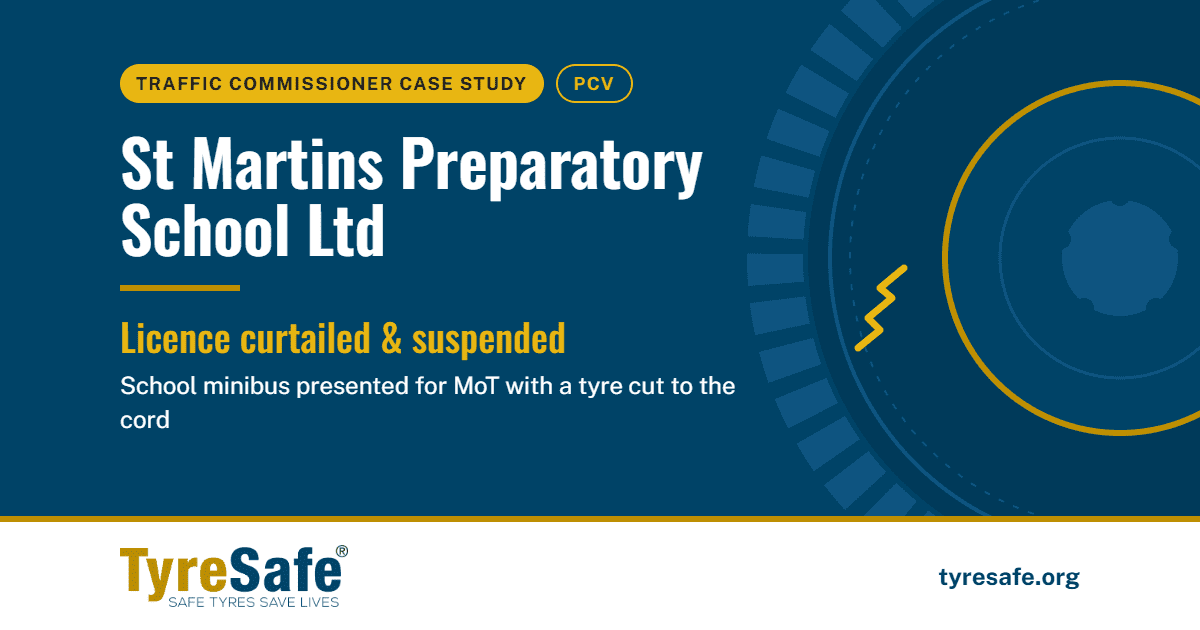
This case concerns a school that operates minibuses under a restricted PSV licence to transport pupils. One of its minibuses was presented for its MoT with a tyre cut to the cord – a defect the Deputy Traffic Commissioner described as road safety critical. The operator could not explain how the vehicle had reached that condition, and the defect was never investigated at the time.
The tyre failure was a symptom of a wider problem: the directors had left transport compliance to school staff who had no formal transport training or experience. Safety inspections were not carried out at the promised intervals, maintenance records were not kept properly, and the operator could not even confirm who its current maintenance provider was. For any organisation carrying passengers – and especially children – this case is a clear reminder that tyre safety depends on robust daily checks and management control, not on the MoT test.
Background & Public Inquiry Context
- Licence history: The restricted PSV licence was granted in 2019 for two vehicles. The company is part of a private education group with several other licensed companies under common ownership or directorship.
- Earlier intervention: In 2024 the operator came to the Traffic Commissioner’s attention for failing to cooperate with a DVSA investigation, and agreed to arrange an independent audit in 2025. A traffic examiner’s report had already identified shortcomings.
- Tyre-related MoT failure: In March 2025 a minibus was presented for MoT with a tyre cut to the cord. No investigation followed and no one was held to account.
- Audit and further investigation: The independent audit in September 2025 raised further compliance concerns, prompting the Traffic Commissioner to ask DVSA to investigate again. DVSA visits in March 2026 raised more concerns, after which the operator took its vehicles out of service while it reviewed its procedures.
- Group history: Two other licences in the group had previously been revoked after failing to respond to “propose to revoke” procedures, and further applications by companies with common directors had been refused.
- Call-up: The operator was called to public inquiry on 30 July 2026, with the Traffic Commissioner considering maintenance, undertakings, material changes, good repute and financial standing.
DVSA Investigation & Tyre-Related Call Outs
1. A tyre cut to the cord
A tyre cut deep enough to expose the cords has lost part of its structural integrity and is at real risk of sudden deflation or blowout – particularly on a loaded minibus at speed. A cut exceeding 25mm or 10% of the section width that is deep enough to reach the ply or cord, or any exposed ply or cord, makes a tyre illegal under the Road Vehicles (Construction and Use) Regulations 1986.
Damage of this kind does not appear between one MoT and the next unnoticed – it should be picked up by a driver’s daily walkaround check or at a safety inspection. That the vehicle reached the MoT station in that condition, and that the operator could not explain why, pointed to a breakdown in both driver checks and maintenance oversight.
2. Maintenance intervals and record-keeping
- Vehicles were not inspected at the 10-week safety inspection intervals the operator had committed to in its licence application.
- The operator failed to honour its undertakings to keep vehicles fit and serviceable and to keep proper maintenance records.
- The MoT first-time pass rate was described as low.
- At the inquiry the operator could not confirm who its current maintenance inspection provider was.
3. Broader compliance failures
- Vehicles were used without operator discs displayed and with an incorrect MoT classification.
- Drivers’ hours undertakings were not met, and the operator questioned at the inquiry whether drivers’ hours rules applied to it at all.
- Vehicle changes made in July 2026 were not notified on the Vehicle Operator Licensing (VOL) system until the day before the inquiry.
- Day-to-day compliance had been left to school staff without formal transport training or experience, and no responsible person had been named for the licence.
Traffic Commissioner’s Determination
- Seriousness: The Deputy Traffic Commissioner found that negative features far outweighed positive ones and placed the case in the “serious” category, describing it as persistent operator licence failures with an inadequate response. He had considerable doubts as to whether the operator could be trusted to comply in future.
- Revocation avoided – narrowly: Credit was given for the operator frankly accepting the DVSA findings, withdrawing its vehicles from service, undertaking some training and cooperating with enforcement. On that basis the Deputy Traffic Commissioner stepped back from revocation, but only by the thinnest of margins.
- Curtailment: The licence was limited to one vehicle from 23:45 on 14 September 2026 until further order.
- Suspension: The licence was suspended in its entirety for 14 days, from 23:45 on 25 September to 23:45 on 9 October 2026.
- Undertakings: The operator must commission an independent audit of its transport safety and compliance systems (covering maintenance and drivers’ hours) in March 2027, file the report and its implementation proposals by 30 April 2027, and confirm a named responsible person by 8 October 2026. The one-vehicle limit may be lifted if the audit is satisfactory.
- Warning: The operator was warned that any further public inquiry could lead to significant regulatory action, potentially affecting linked licences in the group.
Key Tyre Safety & Compliance Takeaways
- Walkaround checks must include tyres – every day: Drivers should check every tyre for cuts, bulges, exposed cords, tread depth and pressure before each journey, and defects must be reported and fixed before the vehicle is used.
- The MoT is not a safety check: A tyre cut to the cord at an MoT means the vehicle may have been carrying passengers in that condition. Safety inspections must happen at the intervals promised on the licence, with tyres examined and findings recorded.
- Investigate every safety-critical failure: An MoT failure for a dangerous tyre should trigger an investigation into how it was missed and what needs to change in driver checks and inspections.
- Compliance needs competent people: Organisations running minibuses as a secondary activity – schools, charities, community groups – must make sure the people responsible for transport have the training, time and authority to manage it, and that directors stay accountable.
- Know your maintenance provider and keep the records: Operators should always be able to name their inspection provider and produce complete, up-to-date maintenance and defect records.
Source: Traffic Commissioner decision – St Martins Preparatory School Limited (PB0001701), GOV.UK