New TyreSafe analysis of nearly 137,000 vans finds that for 3–3.5 tonne vans the risk doubles. TyreSafe urges fleets to treat every tyre advisory as a job to be done, not a note on a certificate.
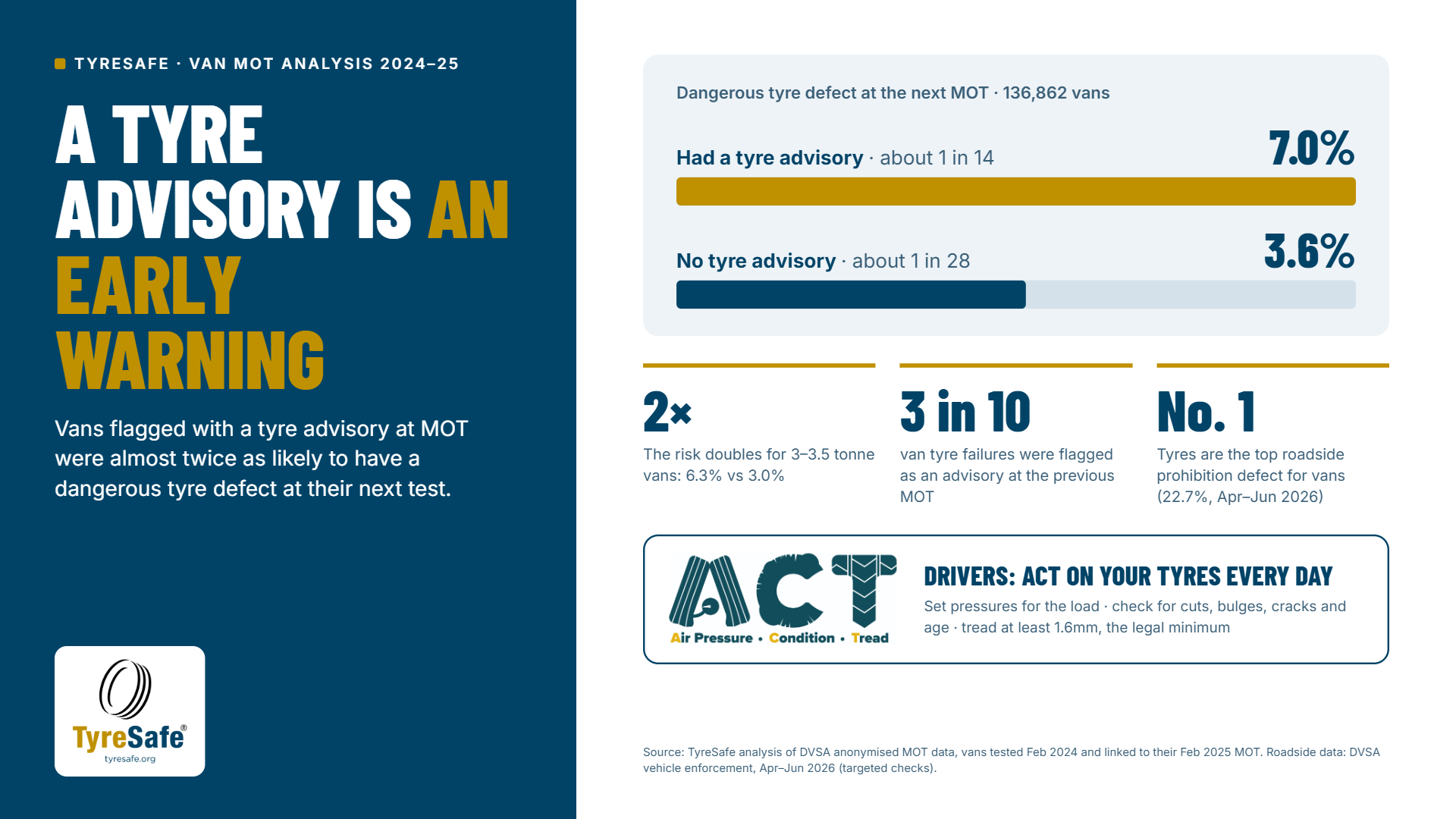
Vans given a tyre advisory at their MOT are almost twice as likely to have a dangerous tyre defect when they come back for their next test, according to new TyreSafe analysis of DVSA MOT data. Around one in 14 vans with a tyre advisory (7.0%) had a dangerous tyre defect at their next MOT, compared with around one in 28 (3.6%) of vans without one.
For large vans of 3–3.5 tonnes, the risk doubles: 6.3% against 3.0%. The gap remains after allowing for the age of the vehicle.
Of the nearly 27,600 vans given a tyre advisory in February 2024, more than 1,900 returned in February 2025 with a tyre defect graded Dangerous. DVSA's advice for a dangerous defect is that the vehicle should not be driven until it has been repaired.
The warning is often there in advance. Around three in ten van tyre failures had been flagged with a tyre advisory at the vehicle's previous MOT.
At the roadside, tyres are the most common reason DVSA takes action against a van. In April to June 2026, tyre condition was the top prohibition defect for vans, recorded against 22.7% of vans inspected. DVSA targets vans it suspects are overloaded or unroadworthy, so this is not a rate for all vans, but it shows how often neglected tyres stop a working vehicle.
The stakes are high for business. There are 4.89 million vans licensed in the UK, and they cover around one mile in every six driven on Britain's roads. About one in five vehicles involved in a collision while being driven for work is a van. Employers have a legal duty to manage the risks of work-related driving, and a van off the road means missed jobs and lost income.
A tyre advisory is an early warning – act on it
Stuart Lovatt, Chair of TyreSafe, said:
"An MOT tyre advisory is an early warning, and our analysis shows it is a reliable one. Vans that get one are almost twice as likely to have a dangerous tyre a year later. That is a risk to the driver, to everyone around them, and to the business that depends on that van.
"Fleet managers already have this information on the MOT certificate. The fix is simple: treat every tyre advisory as a job with a deadline, and make sure drivers ACT on their tyres every day."
What fleet managers should do
- Log every tyre advisory and give it a repair or re-inspection date. Don't leave it until the next MOT.
- Close it out. Confirm the tyre has been replaced or re-checked, and keep a record.
- Build tyres into daily walkaround checks, with a clear way for drivers to report a problem.
- Set pressures for the load, using the vehicle manufacturer's figures.
- After any wheel removal, make sure wheel nuts are tightened to the specified torque and re-checked.
What drivers should do: ACT
- A – Air pressure: check with an accurate gauge, against the manufacturer's figure for the load carried.
- C – Condition: look for cuts, bulges, cracks, embedded objects and uneven wear, especially after hitting a kerb or pothole. Check the tyre's age on the four-digit date code.
- T – Tread: the legal minimum for vans up to 3.5 tonnes is 1.6mm across the central three-quarters of the tread, around the whole tyre.
This is the first in a weekly series of TyreSafe releases on tyre safety and fleet risk management.
About the analysis
TyreSafe analysis of DVSA anonymised MOT test data. It covers vans (MOT class 7, plus class 4 vans identified by model) with an MOT in February 2024, linked to the same van's next MOT in February 2025, about 11–13 months later (136,862 vans). In both years only the initial test is counted, not any retest. Dangerous means a tyre defect graded Dangerous. Vans that failed on tyres at the first test are excluded.
| Group | Dangerous tyre defect at next MOT: had tyre advisory | Dangerous tyre defect at next MOT: no tyre advisory | Relative risk (95% CI) |
|---|---|---|---|
| All vans | 1,931 of 27,573 (7.0%) | 3,929 of 109,289 (3.6%) | 1.95 (1.85–2.05) |
| Vans 3–3.5t (class 7) | 453 of 7,138 (6.3%) | 988 of 32,824 (3.0%) | 2.11 (1.89–2.35) |
| Vans under 3t (class 4) | 1,478 of 20,435 (7.2%) | 2,941 of 76,465 (3.8%) | 1.88 (1.77–2.00) |
Adjusting for vehicle age makes little difference (class 7: 2.04). The figures show an association, not cause and effect. Repairs made between tests can't be seen in the data, so the real effect of leaving an advisory unresolved is likely to be understated. Around half of vans link to a February 2025 test. The rest were tested in another month or left the fleet, and this was similar for both groups.
Sources and context
- "Three in ten". Class 7: 31.1%; class 4 vans: 34.1%. These are February 2025 van tyre failures where the vehicle's previous MOT could be traced.
- Roadside checks. DVSA vehicle enforcement data, April–June 2026, GB-registered light goods vehicles. Tyre condition was the top prohibition defect, recorded against 22.68% of LGVs inspected (21.91% in January–March 2026). DVSA targets its checks, so this is not a fleet-wide rate. (Motester summary)
- Van fleet and work driving. Department for Transport: Vehicle licensing statistics: 2025 (4.89 million licensed vans, end 2025); Road traffic estimates in Great Britain: 2025 (58.8 billion van miles, around one in six); Reported road casualties GB 2025, driving-for-work estimates. Via TyreSafe vehicle statistics.
- Employer duty. HSE, Driving at work: managing work-related road safety (INDG382).