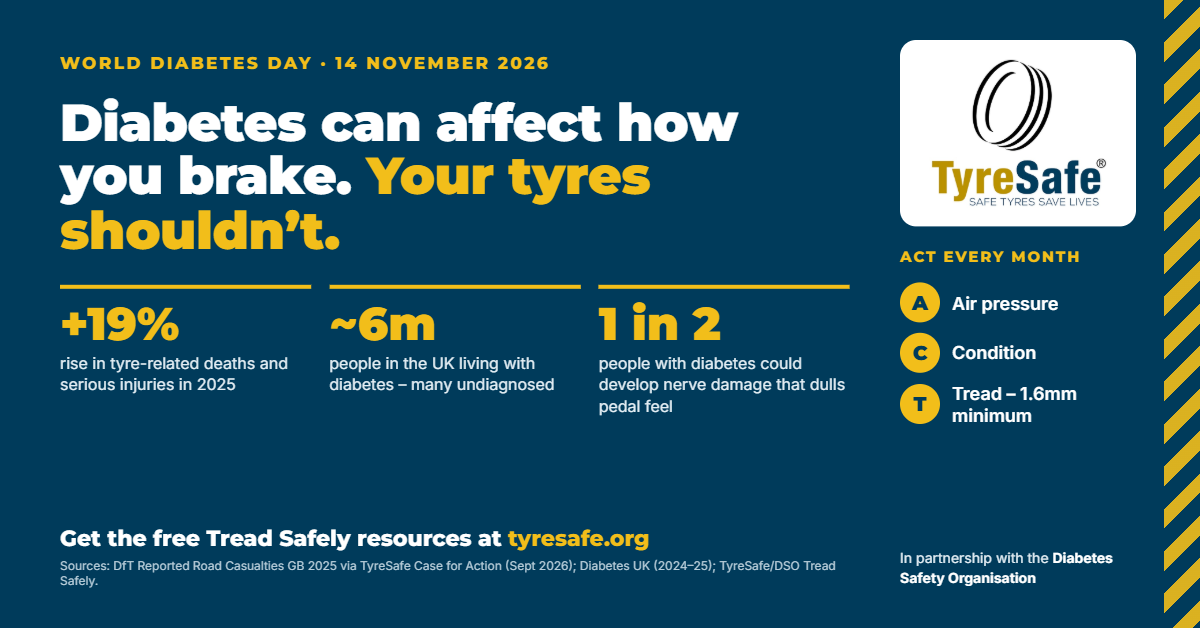
Ahead of World Diabetes Day on Saturday 14 November, TyreSafe and the Diabetes Safety Organisation (DSO) are renewing their call for drivers, employers and fleet operators to use the free ‘Tread Safely’ resources, as the latest figures show the number of people killed or seriously injured in tyre-related collisions on Britain’s roads rose by 19% in 2025.1
Launched in June 2025, Tread Safely highlights how diabetic peripheral neuropathy (DPN) – nerve damage that can reduce feeling in the feet – can affect pedal control and delay braking, and why safe, legal, correctly inflated tyres matter even more for drivers living with the condition. This year’s World Diabetes Day theme, ‘Early action on diabetes’,2 reflects the campaign’s core message: small, early checks on your health and on your tyres can prevent serious harm.
Diabetes: a growing and often hidden risk
Diabetes UK estimates that almost 6 million people in the UK are now living with diabetes – an all-time high – including more than 4.7 million with a diagnosis and almost 1.3 million who may have type 2 diabetes without knowing it. A further 6.9 million people are at increased risk of type 2 diabetes.3 Up to half of people with diabetes could develop DPN, and it can be present even when diabetes has not yet been diagnosed.4
For people who drive for work, the risk is greater still. DSO’s Hiding in Plain Sight report, produced with PACTS and Driving for Better Business, found that people who drive for a living are twice as likely to develop diabetes, with an estimated 1 in 6 commercial drivers already living with the condition. In driving simulations, drivers with neuropathy were three times more likely to lose control of their vehicle, and up to 40% of insulin-treated drivers have not declared their condition to the DVLA.5
Tyre safety: the 2026 Case for Action
TyreSafe’s updated Case for Action,1 based on the Department for Transport’s 2025 road casualty statistics published in July 2026, shows:
– 201 people were killed or seriously injured in 2025 in collisions where police recorded defective tyres as a contributory factor, including 10 deaths – up 19% on the previous year.
– Tyre-related deaths and serious injuries are now 21% above the baseline of the Government’s Road Safety Strategy, compared with a 3% rise for all deaths and serious injuries over the same period.
– On motorways, defective tyres were recorded in 2.4% of collisions – four times the all-roads rate of 0.6%.
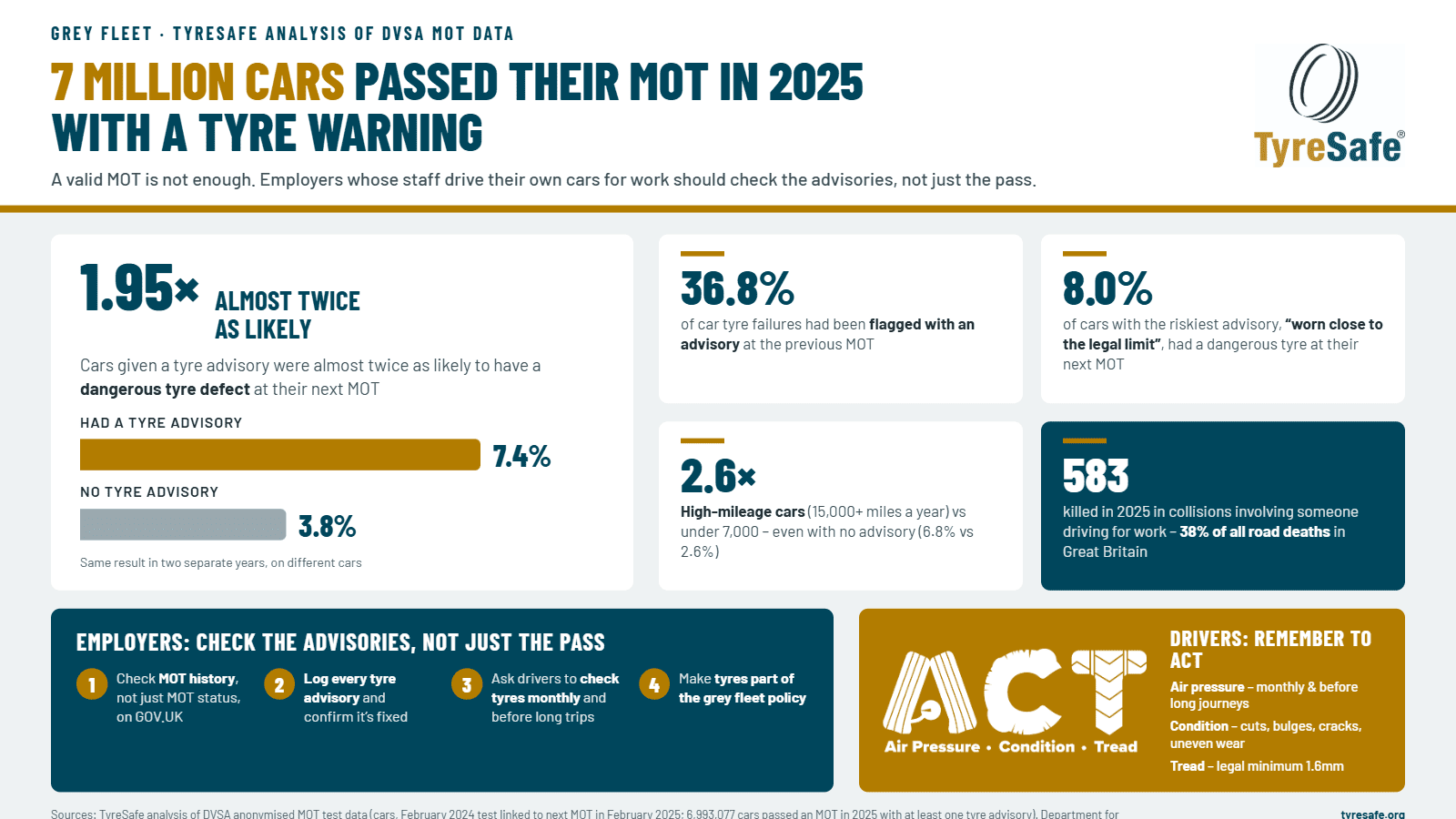
– Around 2.15 million MOT tests fail on tyres each year, and tyres account for 61% of dangerous defects found on cars and light vans.
– At 70mph on a wet road, tyres at the 1.6mm legal limit add around 27 metres to stopping distance compared with tyres in good condition.
For a driver with DPN, who may already be slower to feel the pedals and to brake, the grip and stopping performance provided by well-maintained tyres is a vital safety margin. Worn, damaged or under-inflated tyres erode that margin – particularly in the wet, autumn and winter conditions drivers are facing now.
Stuart Lovatt, TyreSafe Chair, said, “These latest figures are a stark reminder that tyre-related deaths and serious injuries are moving in the wrong direction. For anyone living with diabetic peripheral neuropathy, reaction times and pedal feel may already be affected, so the condition of their tyres can make the difference between stopping in time and a collision. Tread Safely gives drivers and employers clear, practical steps, and a monthly ACT check takes just a few minutes.”
Kate Walker, CEO of the Diabetes Safety Organisation, added, “World Diabetes Day is about early action, and that applies on the road as much as anywhere. Many people don’t yet know they have diabetes, and many more don’t realise how complications such as neuropathy can affect their driving. Through our continued partnership with TyreSafe, we want every driver living with diabetes, and every employer with people who drive for work, to understand the risks and the simple steps that reduce them.”
Continuing the partnership
TyreSafe and DSO continue to work closely together to highlight further diabetes-related risk factors that can be reduced through proper tyre and vehicle maintenance. Their next joint campaign, ‘See Safely’, is in development and will focus on how diabetes can affect a driver’s vision.
Diabetes affects eyesight in several ways, including diabetic retinopathy (26% of people with diabetes), cataracts (32%) and glaucoma (7%).8 People with undiagnosed or ineffectively managed diabetes over a long period are particularly at risk of eye damage. Diabetic retinopathy treated with laser is one of the eye conditions drivers must report to the DVLA,6 and the number of people diagnosed with diabetic retinopathy in the UK is projected to pass one million by 2030.7 When hazards are seen later, drivers have less time and distance in which to stop – making good tyres even more important.
Free Tread Safely resources
Drivers, employers and fleet operators can download the free Tread Safely leaflet, poster, social media graphics and campaign video from the TyreSafe Resources Area at www.tyresafe.org, and read the guidance on driving with DPN at tyresafe.org/resources/articles/tread-safely-diabetes-tyre-safety. Employers can download DSO’s Hiding in Plain Sight report and risk assessment tools at diabetessafety.org/hiding-in-plain-sight.
The campaign reinforces TyreSafe’s ACT message:
– Air pressure – Check tyre pressures at least once a month and before long journeys, to maintain safe handling and grip.
– Condition – Inspect tyres for cuts, bulges, cracks and other damage.
– Tread – Ensure tread depth is above the legal minimum of 1.6mm across the central three-quarters of the tyre, for effective braking, particularly in wet weather.
Tread Safely also encourages drivers with diabetes to check their feet daily, attend regular diabetes and eye checks, speak to their healthcare team about any changes in sensation or vision, and make sure the DVLA is informed where required.