

As the only point of contact between your car and the road, your tyres need to perform perfectly every time you get behind the wheel – this means that (pardon the pun) they cannot crack under pressure! Understanding tyre cracking is an essential part of being a safe driver and keeping your vehicle in tip-top condition.
In this handy guide, we’ll explain what tyre cracking is, break down the common causes for it, and show you how to spot cracking in your tyre tread and sidewall. We’ll also explain how to prevent and address this tyre defect and answer some of your frequently asked questions.
Sections
- What is tyre cracking?
- Why do tyres start cracking?
- How do you know if your tyre is cracked?
- Are cracked tyres dangerous?
- How to prevent tyre cracking
- FAQs
What is tyre cracking?
Cracking is a tyre defect that occurs when the polymer bonds in the rubber begin to degrade, creating visible ‘cracks’ along the surface of the tyre. These usually occur on either the sidewall or the tread and while they might start small, they can widen and deepen over time. Tyre cracking is also known as ‘dry rot’.
Cracks compromise the structural integrity of your tyre, which can lead to a rougher ride, punctures and deflation at best, and a loss of traction and blowouts at worst.

Why do tyres start cracking?
Tyres may start cracking for several reasons. The most common causes include:
- Ageing
- Incorrect tyre pressure
- UV exposure and heat
- Water penetration
Ageing
Over time, the rubber in tyres naturally degrades and breaks down. This makes tyres hard, brittle, and more susceptible to cracking. This can happen with regular driving and the wear and tear that comes with that, but rubber degradation can happen even if you drive your vehicle infrequently. In fact, it is recommended that you do drive your vehicle frequently, as this helps to release the chemical that prevents tyres from drying out!
For this reason, motorcyclists and motorhome drivers, who may store their vehicles for the winter and bring them back out for spring and summer, should be extra-vigilant about tyre cracking.
Under or overinflation
Under or overinflating your tyres can also lead to cracking. If your tyres aren’t inflated enough, the sides of the tyre will flex more and connect with the road. This can create a build-up of heat and friction which can lead to cracking. On top of this, underinflated tyres can also impact traction and by extension, how quickly your car responds to braking.
Similarly, over-inflated tyres can cause problems. If your tyres are over-inflated, more pressure is being applied to the tyre walls, reducing the rubber’s ability to flex and respond to the road conditions. With this greater stress and reduced flexibility, the rubber can become stretched and overheated and as a result, brittle and prone to cracking. Over-inflated tyres will also wear unevenly and be less able to absorb impacts, like debris or potholes.

UV rays & heat
UV rays and temperature fluctuations can also cause tyre cracking. Whether you create heat through friction, or it is just something your tyre is subject to on warmer days, heat impacts how the rubber polymers behave. The polymers expand in the heat and contract in the cold. And, over time, this repetitive cycle of expansion and contraction can deteriorate and weaken the rubber, leading to cracks.
UV rays can also cause tyre cracking through a chemical reaction that oxidises – or breaks down – the rubber compounds, making them harder and less flexible. This is one of the reasons that tyres are black! Carbon black helps to shield the rubber against UV rays by distributing and dissipating their effects.
Water
While your tyres are largely waterproof – they aren’t entirely waterproof! This is particularly the case if they are already showing signs of wear or if you regularly drive in wet or icy conditions. If water penetrates the rubber seal, it can break down the rubber molecules over time, making the rubber less flexible and more vulnerable to cracking. This process can be sped up by the freeze-thaw cycle, where water molecules expand and contract the rubber molecules with seasonal fluctuations in temperature.
How do you know if your tyre is cracked?
It’s important to identify and deal with tyre cracks as quickly as possible. Here are some things to look for when examining your tyres:
- Visible cracks on the sidewall or tread – These might be fine lines or larger ‘cuts.’
- Signs of discolouration or dryness – Your tyres may have a faded or chalky appearance or feel stiff to the touch.
- Bugles or deformities
- Wear or damage to the tread
- Underinflation
You might also notice issues while driving. Your drive may feel less smooth, and your vehicle may make unusual noises or handle poorly. If you have a Tyre Pressure Monitoring System (TPMS), it might warn you about issues with your tyre pressure.
Tyre sidewall cracking
If your tyre sidewall is cracking, it may look like this:

Sidewall cracks appear on the smooth, vertical outer surface of the tyre—the area without tread. These cracks often look like:
- Thin, spiderweb-like lines spreading across the sidewall
- Small slits or splits running horizontally or diagonally
- Cracks that deepen over time, sometimes forming small gaps
- Multiple cracks in clusters, giving the rubber a dry, aged appearance
- A grey, dull, or chalky look to the rubber around the cracks
Sidewall cracks are more dangerous because they weaken the part of the tyre that flexes and supports the vehicle’s weight. Even small sidewall cracks can indicate structural deterioration.
Tyre tread cracking
If your tyre tread is cracking, it may look like this:

Tread cracks appear on the patterned, contact surface of the tyre—the part that touches the road. These typically look like:
- Small fissures between tread blocks
- Thin cracks running along the grooves
- Shallow surface cracks caused by ageing or UV exposure
- Cracks that appear only on the outer edges of the tread, especially on older tyres
Tread cracking usually starts as fine, superficial lines, and these cracks may be shallower than sidewall cracks. While tread cracks can also worsen and become unsafe, early-stage tread cracking is sometimes less immediately severe than sidewall cracking—though still a sign the tyre is ageing.
Early signs – How to tell if tyres are starting to dry rot?
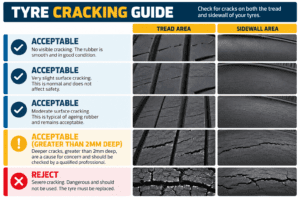
Some early signs that your tyres might be beginning to crack might be fine, spiderweb-like lines on the sidewall, small splits in the tread blocks or slight discolouration of the rubber.
There are tyre cracking charts available to help you picture early-stage dry rot, but it can be difficult to judge how serious the issue is without experience. If you are unsure, it’s best to have the tyres checked by a garage.
Are cracked tyres dangerous?
Yes — cracked tyres are dangerous, and the risks increase the longer they are used. Here’s why:
1. Reduced Structural Strength
Tyre rubber ages and weakens over time. Cracks—whether small surface cracks or deeper sidewall cracks—indicate that the tyre has lost elasticity. This makes the tyre more likely to fail under pressure, especially at high speeds or when hitting potholes.
2. Increased Risk of Blowouts
Cracks can allow air to escape or weaken the internal layers of the tyre. This can lead to a sudden blowout, which is one of the most dangerous tyre failures because it causes immediate loss of control.
3. Poor Traction and Grip
Cracking often goes hand-in-hand with hardening of the rubber. Hardened, cracked tyres have less grip, especially in wet conditions, increasing the chance of skidding or longer braking distances.
4. Water Penetration
Cracks allow moisture to enter the tyre structure. Water can damage steel belts inside the tyre, causing corrosion, separation, and eventual tyre failure.
5. Sidewall Cracks Are Especially Serious
The sidewall supports the weight of the vehicle. Cracks here mean the tyre can no longer safely carry load and is at high risk of bulging or catastrophic failure.
Are cracked tyres legal?
Small, superficial cracks in your tyre are not illegal, but larger, deeper cracks are, particularly when the internal ply, cords and fabric are exposed.
How to prevent tyre cracking
There are some actions you can take to prevent your tyres from cracking. You should:
- Park in shaded or covered areas or use tyre covers to protect your tyres from UV rays
- Clean your tyres regularly to prevent the build-up of dirt, oil or fungus that can break down the rubber compounds
- Drive regularly and drive mindfully, trying to avoid rough surfaces
- Rotate your front and rear tyres to evenly distribute wear and tear
- Keep an eye on the age of your tyres – which you can find on the tyre sidewall.
You should also regularly check your tyres to make sure they are in optimal condition, have the correct tyre pressure, and have the proper tread depth.
How long should tyres last before cracking?
There is no exact mileage or time limit for when tyres will start cracking, but most tyres begin to show signs of ageing after around 5–6 years.
How long your tyres last before cracking will depend on how well you have taken care of them and the conditions they are exposed to. Rubber naturally degrades over time, even if the tyres are not heavily used, so regular checks are important.
FAQs
Still have questions about tyre cracking? We’ve answered some of your frequently asked questions below.
Is it safe to drive on tyres with cracks?
No. If you notice cracking on your tyres, you should get them replaced as soon as possible. While cracks may start as relatively small and inconspicuous, they can develop quickly and should be treated seriously. Because you cannot predict when a cracked tyre will fail, the safest option is to replace it as soon as cracks appear, especially if they are on the sidewall, are deep, or the tyre is older than a few years.
Is a little cracking on tyres okay?
Small, superficial cracking on tyres may not be an immediate safety issue, but it should not be ignored. Even minor cracks can be an early sign of rubber ageing and may develop into a more serious problem over time. If any cracking is visible, it’s always worth having the tyres inspected by a tyre professional.
How long can you drive on cracked tyres?
There’s no safe amount of time to drive on cracked tyres, because once cracks appear, the tyre has already begun to degrade and can fail unpredictably. How long they will last cannot be accurately estimated – they might hold for weeks, or they might fail on your next trip. The risk depends on factors like the depth and location of the cracks, tyre age, driving speed, load, and road conditions.
Are cracked tyres an MOT failure?
Your vehicle will fail its MOT if there are any signs of cracking on the sidewall or tread. MOT testers check tyre condition as part of the inspection, and signs of cracks in the tyre’s sidewall or tread that are significant enough to indicate damage or ageing can lead to a fail because they make the tyre unsafe to use on public roads.
Can you repair cracks in tyres?
Unlike punctures, cracked tyres cannot be repaired. This particular tyre defect is a permanent and irreversible breakdown of the rubber components and as such, repairs aren’t safe or cost-effective. Cracks, especially in the sidewall, weaken the part of the tyre that flexes the most and carries the vehicle’s weight. Because of this, the tyre becomes more prone to sudden blowouts, and repair is not considered safe or legal.
When should you replace cracked tyres?
You should replace cracked tyres as soon as the cracks indicate structural ageing rather than minor surface wear, because once the rubber deteriorates, the tyre can fail without warning. Replacement is necessary when cracks appear on the sidewall, when they are deep (more than about 1–2 mm), when they run all the way around the tyre, or when cracking is accompanied by other symptoms such as vibration, bulging, or repeated loss of air pressure.
Learn more about tyres and tyre safety
At TyreSafe, we are dedicated to raising awareness of the importance of tyre safety. Stay safe and sound and road-ready with our tyre help and advice.