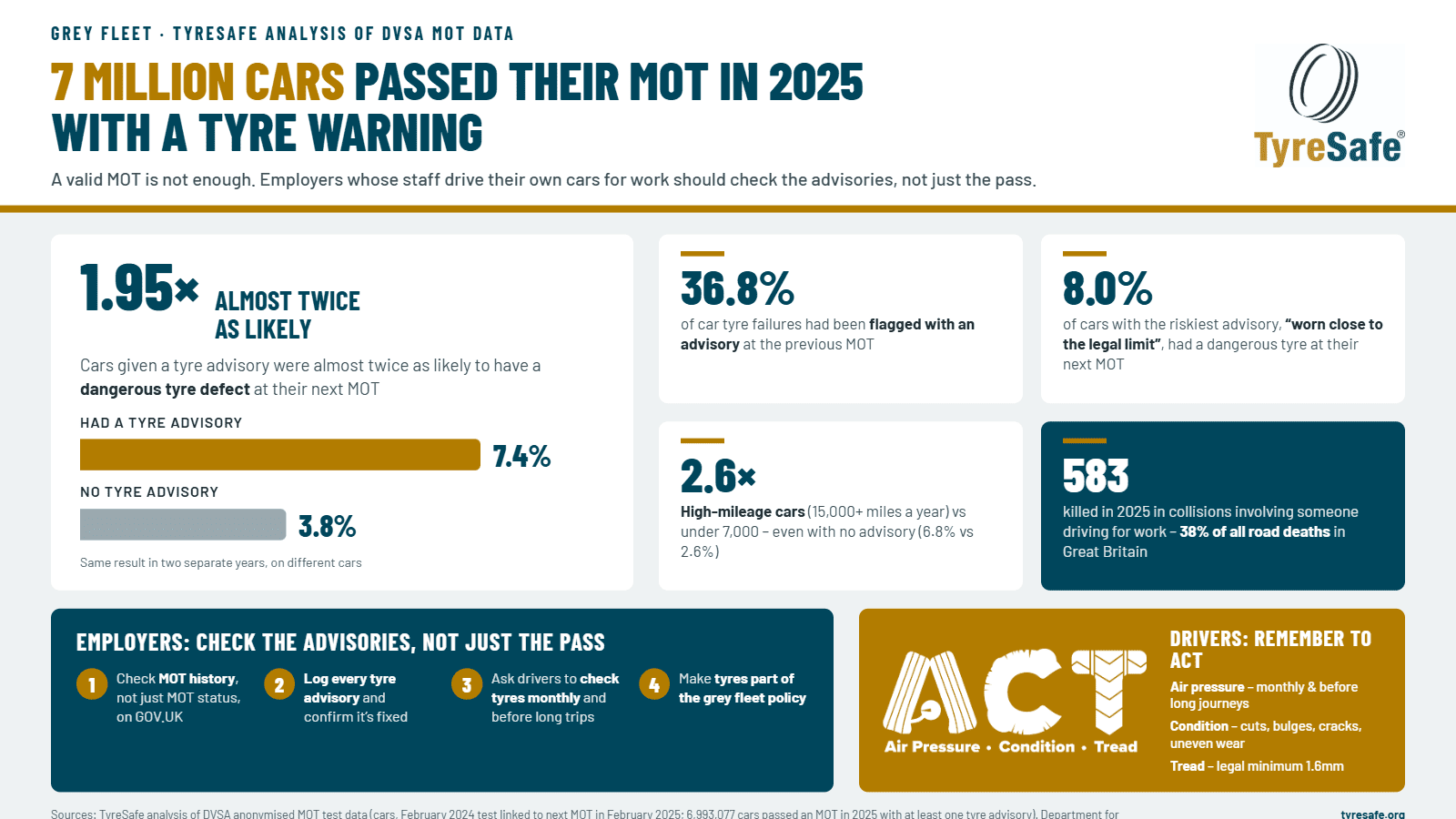
Cars given a tyre advisory are almost twice as likely to have a dangerous tyre at their next MOT. TyreSafe urges employers whose staff drive their own cars for work to check the advisories, not just the pass.
Almost 7 million cars passed their MOT in 2025 with a tyre advisory, according to new TyreSafe analysis of DVSA MOT data. For employers whose staff use their own cars for work – the “grey fleet” – a valid MOT can hide a tyre that is already wearing out.
Cars given a tyre advisory were almost twice as likely to have a dangerous tyre defect at their next MOT: 7.4% against 3.8%. The finding held in two separate years, on different cars, and closely matches TyreSafe’s results for vans published last week.
The warning is often there in advance. More than a third (36.8%) of car tyre failures had been flagged with a tyre advisory at the car’s previous MOT. The riskiest advisory is “worn close to the legal limit”: 8.0% of cars given one had a dangerous tyre defect at their next MOT.
Mileage adds to the risk. High-mileage cars, covering more than 15,000 miles a year, were 2.6 times as likely to have a dangerous tyre at their next MOT as cars covering under 7,000 miles – even when they had no tyre advisory at all (6.8% against 2.6%). For drivers clocking up business miles, tyres can wear out well before the next test.
The stakes are high. In 2025, 583 people were killed in collisions involving someone driving or riding for work – 38% of all road deaths in Great Britain. HSE guidance says employers should make sure privately owned vehicles used for work are safe.
“A valid MOT should be the start of the conversation, not the end of it”
Stuart Lovatt, Chair of TyreSafe, said: “Seven million cars passed their MOT last year with a tyre warning. If one of them is being driven for work, the employer needs to know – and a simple ‘valid MOT’ check won’t tell them.
“Imagine a district nurse driving between patients in a car with a valid MOT, but an advisory saying a tyre was worn close to the legal limit. That is exactly the risk a grey fleet policy should catch. Read the advisory, log it, and make sure it’s fixed.”
What employers should do
- Check MOT history, not just MOT status. GOV.UK’s free Check MOT history service shows any advisories for a car from its registration.
- Log every tyre advisory, agree a date with the driver to replace or re-check the tyre, and confirm it has been done.
- Ask drivers to check their tyres at least monthly and before long journeys, and more often if they cover high business mileage.
- Make tyres part of the grey fleet policy, alongside licence, business insurance, MOT and tax checks.
What drivers should do: ACT
- A – Air pressure: check at least monthly and before long journeys, against the vehicle manufacturer’s figures.
- C – Condition: look for cuts, bulges, cracks, embedded objects and uneven wear. Check the tyre’s age on the four-digit date code on the sidewall.
- T – Tread: the legal minimum for cars is 1.6mm across the central three-quarters of the tread, all the way around the tyre.
This is the second in a weekly series of TyreSafe releases on tyre safety and fleet risk management.
ENDS
Notes to editors
- About the analysis. TyreSafe analysis of DVSA anonymised MOT test data. It covers cars (MOT class 4, excluding vans and pick-ups identified by model name) with an MOT in February 2024, linked to the same car’s next MOT in February 2025, about 11–13 months later. In both years only the initial test is counted, not any retest. Cars that failed on tyres at the February 2024 test are excluded. “Dangerous” means a tyre defect graded Dangerous.
| Outcome at next MOT | Had tyre advisory | No tyre advisory | Relative risk (95% CI) |
| Dangerous tyre defect | 24,017 of 325,431 (7.4%) | 40,354 of 1,068,827 (3.8%) | 1.95 (1.92–1.99) |
| Any tyre fail | 9.4% | 5.2% | 1.82 (1.79–1.84) |
Adjusting for vehicle age makes little difference (1.91). The figures show an association, not cause and effect. Repairs made between tests can’t be seen in the data, so the real effect of leaving an advisory unresolved is likely to be understated. About 58% of cars with an advisory and 59% without one link to a February 2025 test.
- Two separate years. To test whether the finding repeats, cars were split at random into two halves by vehicle ID, so no car is counted twice. February 2023 to February 2024: 7.5% vs 3.8% (1.97 times). February 2024 to February 2025: 7.3% vs 3.8% (1.92 times).
- 7 million cars. 6,993,077 cars passed an MOT in 2025 with at least one tyre advisory on the passing test. Each car is counted once, however many tests it had.
- More than a third.8% of February 2025 car tyre failures where the car’s previous MOT could be traced had a tyre advisory at that previous test.
- Worn close to the legal limit.0% of cars with this advisory had a dangerous tyre defect at their next MOT, 2.13 times the rate for cars with no tyre advisory.
- Annual mileage is worked out from the odometer readings at the two linked tests. Among cars with no tyre advisory, 6.8% of those covering more than 15,000 miles a year had a dangerous tyre defect at their next MOT, against 2.6% of those covering under 7,000.
- Driving for work. Department for Transport, Reported road casualties Great Britain: estimates involving driving for work, 2025, published 24 September 2026. Official statistics in development, using a new method. 583 people were killed in collisions involving at least one person driving or riding for work, of whom 109 were themselves driving or riding for work.
- Employer duty. HSE, Make sure vehicles used to drive or ride for work are safe.